
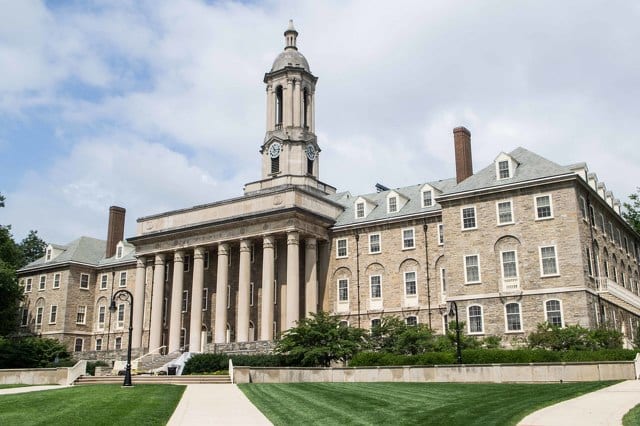
Penn State has made strides on some key issues since the Jerry Sandusky scandal broke in 2011, but the university has significant work to do in a number of areas, Pennsylvania Auditor General Eugene DePasquale said on Thursday.
DePasquale released a performance audit of the university — the first such audit of Penn State ever conducted by the auditor general’s office — which had nine findings and 23 recommendations.
The audit, announced in August 2016 and covering a period from Jan. 1 2013 to March 31, 2017, focused on three major areas: governance and transparency, campus security, and tuition.
‘These areas have been and remain critical areas of importance to Penn State,’ the university said in a response. ‘While the University does not agree with each of the Auditor General’s findings and recommendations, it remains committed to the generations-long partnership with the Commonwealth and its land-grant mission.’
DePasquale was critical of Penn State, along with the three other state-related universities, for what he described as outrageous tuition increases over the past three decades. He also chided university leadership for failing to implement many of the governance reforms recommended by his predecessor, Jack Wagner, in 2012.
And while he said the university has made progress in campus safety measures, there are still inexcusable gaps in screening and background checks for employees and outside staff for academic and sports camps.
For university governance, DePasquale noted that Penn State did adopt some of the changes to its Board of Trustees recommended by Wagner, such as making the university president and Pennsylvania governor non-voting members.
‘In my opinion they did the easy ones,’ he said.
The university needs to follow the recommendations of the 2012 report, and of higher education experts including the American Council of Trustees and Alumni, and reduce the size of the board. Wagner’s report recommended reducing the board from 32 to 21 members, and ACTA says the optimal size is 12 to 15 members.
Instead, Penn State increased the number of board members to 38.
‘It is disappointing many of the recommendations have been ignored or contrary action taken,’ DePasquale said.
A large board results in hindrances to decision-making and information sharing, DePasquale explained. He said he learned Thursday morning, for example, that some board members were not even aware the audit was taking place.
‘The board is too big and too big of a board reduces accountability,’ he said. ‘Information doesn’t get shared. I found out today not every board member was aware of this audit. I wish I was making that up. Somebody needs to answer to how that happened. This was not a secret.’
DePasquale added that Penn State needs to be brought more fully under the purview of the state’s Right to Know Law and the Ethics Act for state employees and officials. Penn State and other state-related university leaders have lobbied against expanding their obligations under the Right to Know Law.
He said that in 2012, when DePasquale was a state representative, former Penn State President Rodney Erickson flatly lied to him in saying he supported including more aspects of Penn State’s operations under the Right to Know Law and then lobbying other legislators against it.
Current President Eric Barron is against it, but has been open about his position, DePasquale said.
‘I have enormous respect for [Barron] and I think he is moving the university forward,’ DePasquale said. ‘I am upset he has taken the position of [Penn State] not being included in the state’s Right to Know Law. But I give him enormous credit for his honesty, which is more than I got from former President Erickson, who lied to me … by telling me he supported Penn State being in the state’s Right to Know Law… then did everything he could to make sure that legislation wouldn’t pass.’
DePasquale’s report also recommends unedited live streaming of public comment at Board of Trustees meetings, which the school recently ended; removing exceptions for term-limits and the five-year waiting period between being a university employee and trustee and vice versa; posting per-trustee expenses online; and modifying the expectations of board membership that requires all trustees to validate board decisions publicly, even when they have dissenting views.
The university’s response cited a number of measures undertaken to improve governance and oversight since 2012.
“Penn State’s board has had more than 30 voting trustees for more than a century,” Board Chairman Ira Lubert said. “Over that time, the University has grown from a farmer’s high school to a world renowned public research institution. It is the level of trustee engagement, not the number of members, which is the critical factor that enables the board to provide the appropriate level of oversight.”
Tuition Increases
Penn State’s tuition for in-state students has climbed by 535 percent in the past 30 years, to the 2016-17 rate of $19,347.
‘That is a very high number,’ he said. ‘I made us go back and review that because I almost couldn’t believe it.’
By comparison, the cost of a gallon of milk over that time period has increased 48 percent, and a new car by 163 percent. Penn State is the third most expensive public university in the nation (Pitt is number one).
“Unless Penn State does something now to rein in attendance costs, even fewer middle-income students will be able to attend Pennsylvania’s acclaimed land grant university,” he said.
DePasquale said he is disturbed by the apparent trend at Penn State and schools across the nation to admit more and more out-of-state and international students as a way of increasing tuition revenue.
He did acknowledge that Penn State receives much less in the way of state appropriations compared to its peers nationally, but, he said Penn State’s expenses are ‘out of control.’ He also suggested that if Penn State implements the major recommendations in the audit, the state may be inclined to provide more support.
Over the past four years, when the university received $1.1 billion from the state, expenses have increased by 10 percent while revenue has grown by 6.5 percent.
‘We do believe their expenses are outpacing income significantly,’ DePasquale said.
His report urges Penn State to develop a task force dedicated to ‘ identifying and lowering costs that are driving tuition into the stratosphere.”
The university needs to prioritize Pennsylvania students when qualifications are equal and the board should have a policy prohibiting tuition increases above the Consumer Price Index.
DePasquale also acknowledged the declining population of college-aged individuals in the state, but he said that does not account for the overall trend.
Penn State’s response said that cost controls have been a focus for decades and that it receives one of the lowest levels of state support in the country. The percentage of Pennsylvania students admitted to the university has remained consistent over the past 15 years at about 68 percent and the school said it has not taken the approach of other state research universities around the country of strategically reducing the number of in-state students in favor of higher-paying out-of-state students.
‘The Legislature’s general support appropriation, used primarily to offset the cost of tuition for Pennsylvania resident students, has steadily decreased over many decades, putting upward pressure on the price of tuition,’ the response said, adding that it has implemented several new programs to lower costs and assisting students with financial need.
“We share the Auditor General’s desire for cost control, and are committed to continuing to work with the Governor and Legislature to address these challenges to keep a world-class Penn State education within reach for all Pennsylvanians,” Barron said.
Campus Security
Penn State has taken a number of steps to improve campus safety and comply with the Clery Act since the Sandusky scandal, but DePasquale said auditors found too many missing background checks for new hires and staff working camps on campus.
“One of the more distressing findings in this audit is that years after Jerry Sandusky’s conviction for sexually assaulting young boys, Penn State fails to ensure the university conducts 100 percent of mandated background checks,” DePasquale said. “In the post-Sandusky era, it would be expected that Penn State would be hyper-vigilant about completing all required background checks. Apparently that is not the case.’
The audit found background checks missing at a rate of 8 percent for academic and sports camps at the university, a statistical sample that would mean missing clearances for at least one person working at 57 of the 732 camps on Penn State campuses in 2016.
Auditors reported an error rate of 4 percent for background checks on new hires, meaning that potentially 962 of 24,382 employees hired in 2016 did not have mandated, pre-employment background checks.
‘The error rate should be zero,’ DePasquale said. “As we so tragically learned from Sandusky, it takes only one child predator to cause what could be lifetime trauma to a child. Penn State officials must end their long-running string of excuses and immediately correct this serious deficiency.”
Penn State, citing extensive new policies implemented for campus safety and security clearances, said missing background checks were not acceptable but took issue with how auditors arrived at their numbers.
‘The Auditor General randomly selected 76 of 732 youth camps held on our campuses for background check compliance. The Auditor General found six of these camps to be missing at least one required background check,’ the university response said. ‘With respect to the Auditor General’s findings related to background checks, Barron said that even one incomplete or missing background check is one too many, and Penn State is closely reviewing protocols. The Auditor General’s statement that 57 of the 732 camps were out of compliance is an estimate based on an assumed extrapolation of his statistical sampling and not based in fact.’
Harsh Words for Erickson, NCAA
While they weren’t a focus of the report, both former university president Erickson and the NCAA earned some sharp criticism from DePasquale during Thursday morning’s news conference.
DePasquale said the Louis Freeh report commissioned by the university to investigate the circumstances surrounding Sandusky’s acts should have been done by an independent agency. He said that, fair or not, it could be argued Freeh was hired ‘to do the bidding of former president Erickson and some members of the board.’
In addition to saying Erickson lied about his position on the Right to Know Law, DePasquale said that decisions in the aftermath of Sandusky’s arrest and charges against Penn State administrators were ‘made in a panic mode by former president Erickson.’
‘It appears from his behavior he was more concerned with protecting his own reputation than the kids [abused by Sandusky] or the school. When you panic, you make mistakes. And those mistakes hurt people.’
Meanwhile, DePasquale said there are only two institutions he believes have less credibility than the NCAA — scandal-plagued FIFA and the International Olympic Committee.
‘Those two institutions are an embarrassment, as is the NCAA,’ he said.
The NCAA, DePasquale said, should have found an independent agency to do a report on what happened with Sandusky and what colleges and universities should do to protection children.
‘Instead, they removed scholarships for future football players,’ he said. ‘Punish the adults all you want… But the NCAA has zero credibility on this. They should have been focused on the protection of the kids. Instead it appears they were taking out their own vendetta on Penn State, and I say this as someone that thinks we put way too much emphasis on college football in the United States.’
Hazing, Second Mile Not Included
DePasquale said the work on the audit was largely concluded before issues of hazing emerged following the death of student and fraternity pledge Timothy Piazza.
He also said the audit did not look at Sandusky’s now-defunct Second Mile charity for at-risk youth, where prosecutors said he found and groomed his victims. DePasquale said auditors will look at how the Second Mile was awarded state grants as part of a capital budget audit beginning in the fall.
More Latest Penn State News
View all Latest Penn State News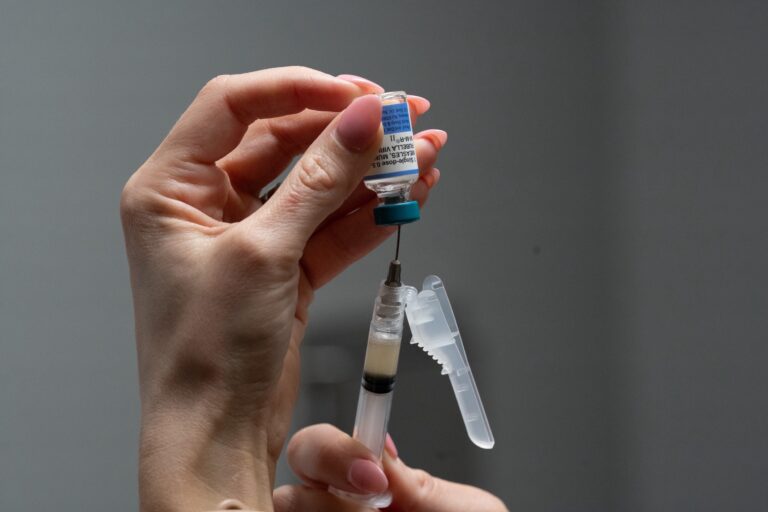
Penn State Urges Prevention as Measles Cases Rise in Pa.
Penn State officials on Thursday urged community members to ensure they are protected against the measles as cases of the virus continue to rise across Pennsylvania and nationally. No confirmed […]
Big Ten Blood Drive Puts Penn State in Race for $1M Grant, Seeks to Boost Supply Amid Critical Shortage
Penn State is asking students, alumni and fans to donate blood as the university joins all 18 Big Ten schools in a competition that could bring a $1 million grant […]
New International Students Adjust to Happy Valley With Hearts Still Connected to Home
Each August for the last 10 years, I’ve written a column about Penn State’s newly-arrived international students. Why that emphasis, you ask? Well, to put it bluntly, our campus and […]


