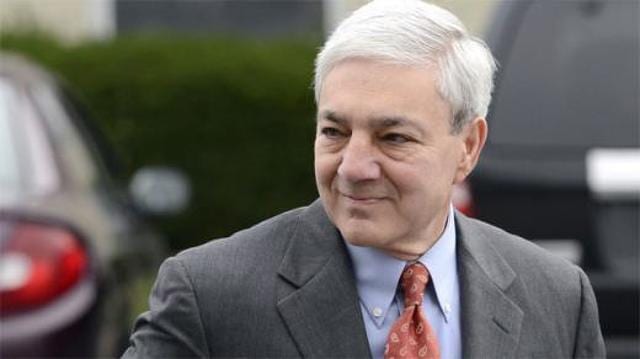
Six of former Penn State President Graham Spanier’s breach of contract claims against the university have been dismissed.
Lebanon County Judge Robert Eby, who is specially presiding in the case, sustained all but one of Penn State’s preliminary objections in Spanier’s civil complaint, alleges that Penn State violated conditions of the separation agreement they signed in November 2011, when Spanier resigned from the presidency in the fallout from the Jerry Sandusky child sexual abuse scandal.
Five of Penn State’s preliminary objections sustained by Eby involved Spanier’s claim that the university violated a non-disparagement clause in the separation agreement. Two of those claims related to comments made through Louis Freeh’s investigative report on how Penn State handled allegations about Sandusky and three others related to statements made by university trustees.
Eby also sustained Penn State’s objection to Spanier’s claim that the university failed to reimburse him for legal fees and other expenses. The one claim left standing as of now is that Penn State failed to provide administrative support once he moved from the presidency to a tenured faculty position.
Spanier has 20 days to file an amended complaint.
Spanier had claimed that statements about him in the Freeh Report and the July 2012 press conference announcing it violated the non-disparagement clause. Eby, however, ruled that the agreement contains no language about negative comments ‘made by attorneys, agents or other unspecified third parties…’
The former president also charged that by the university violated the agreement by publishing links on its website to the Freeh Report, Freeh’s statement to the media and his press conference announcing the report.
‘It’s publication of those links was nothing more than an implied statement: ‘Here is the Freeh Report,” Eby wrote.
‘If Spanier had sought to prohibit Penn State from publishing the negative comments of others or indirectly communicating them to the public… he should have contracted specifically for those provisions.’
Spanier is also suing Freeh for defamation and tortious interference.
Eby sustained Penn State’s objections regarding several comments made by members of the university’s Board of Trustees. Spanier cited six comments made by board members Karen Peetz and Kenneth Frazier at press conferences on July 12 and 13, following the release of the Freeh Report. They included remarks that administrative leadership include Spanier had ‘failed,’ ‘did not put the welfare of children first,’ and concealed what they knew about Sandusky from the board and the public.
The separation agreement, Eby wrote, did not provide for ‘a blanket prohibition of negative comments.’ The agreement provided a specific exemption for negative statements made under legal obligations or “to provide truthful information in connection with ongoing or forthcoming investigations.”
Eby wrote that Spanier has provided no specific allegation that the statements made by Peetz and Frazier ‘were not truthful information offered in connection with an ongoing or forthcoming investigation.’
Objections related to statements by trustee Keith Masser to the Associated Press in June 2012, as well as comments made by several trustees to the New York Times in February 2012, were also sustained by Eby on the same grounds.
Spanier also claimed Penn State has not reimbursed him for legal fees and public relations consultant fees he incurred as a result of the grand jury presentment and his termination as president of the university. He said his legal team hired a PR consultant to address the damage to his reputation caused by Penn State and Freeh, and that he filed a federal lawsuit to gain access to his emails to properly defend himself.
Eby ruled, however, that there is no evidence Spanier has ever presented Penn State with bills for the services, or any record of a demand by Spanier to pay and a refusal to do so by Penn State.
Spanier’s final claim is that the university has not provided him with administrative support, office space and teaching opportunities as stipulated in the separation agreement. He has remained a member of the Penn State faculty in its College of Health and Human Development as part of the agreement, but has been on a leave of absence since leaving the president’s office.
The university objected saying that the termination of his administrative support came as a direct consequence of his indictment in 2012 on failure to report suspected child abuse, child endangerment and perjury, the latter of which has since been quashed by Pennsylvania Superior Court. His employment agreement, Penn State says, stated that he would forfeit administrative support if charged with a felony. They also said there is no clause in the separation agreement prohibiting Penn State from putting him on a leave of absence.
Eby, though, overruled Penn State’s objection on that claim. He wrote that the university has not shown it provided him with the agreed-upon resources even prior to Spanier being charge. He also wrote that the separation agreement states Spanier was terminated without cause and that his employment agreement’s section on without cause termination does not address criminal charges.