
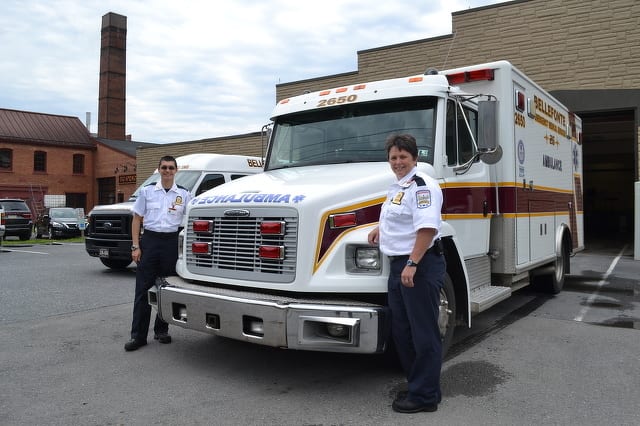
Emergency medical services professionals face an ever-tightening vise as they are squeezed for both personnel and funding.
It is not a new narrative for EMS agencies, especially in rural areas, to have concern over lack of funding, low reimbursement rates for services, fewer volunteers and fewer willing candidates to take paid EMT jobs.
Now, the question is how long some of the agencies can continue under current conditions.
Scott Rhoat is director of Bellefonte EMS and president of the Centre County Ambulance Association, and sits on the board of the Seven Mountains EMS Council. He has worked at all levels of the industry, starting as a volunteer medic with a fire company and climbing his way up through the ranks. He also has worked on the administrative and advocacy sides of the industry.
Lately, Rhoat has been trying to shed public light on the deteriorating situation in which independent EMS agencies find themselves.
MEAGER REIMBURSEMENTS
One of the most obvious problems for EMS agencies is the meager reimbursements they receive from Medicare and Medicaid.
Medicaid will reimburse about 20 cents on the dollar for transporting a patient to the hospital, if there is even a transport at all. If the patient does not get in the rig, EMS gets nothing.
Medicare is a little better, Rhoat said, and will reimburse about 60 cents on the dollar for a transport. For a $600 basic life support ambulance ride, the EMS agency might get $360 back.
Medicare and Medicaid do not recognize EMTs or paramedics as providers. They are recognized as suppliers of transportation.
It does not matter what an EMS agency bills Medicare or Medicaid, because those programs will reimburse only a set amount.
Rhoat said about 15 to 20 percent of patients they serve are on Medicaid — a low amount compared to some areas in Pennsylvania — and about 40 percent of patients have Medicare.
That means some EMS agencies, like Bellefonte, cannot give staffers a raise. Right now, entry-level EMTs start at $9.50 an hour. The average hourly rate across the entire station is $10.40. That’s $10.40 per hour to enter people’s houses at some of the worst moments of their lives; that’s $10.40 an hour to keep someone alive on the way to the hospital after a vicious car crash or other traumatic incident.
At the state level, there is support for increasing the amount Medicaid pays. House Bill 699 passed with no votes against it in the House on June 7. The bill calls for increasing the rate in which EMS is reimbursed for basic and advanced life support by 50 percent, to bring it more in line with Medicare.
That is a good start, Rhoat said.
LOW MEMBERSHIP NUMBERS
Membership rates in Bellefonte’s coverage area are around 11 to 12 percent of the population. Rhoat said that equates to about 4 to 5 percent of its $900,000 budget. An increased membership would help the agency, and it also acts as a kind of second insurance for ambulance rides to the hospital, with Bellefonte EMS covering the out-of-pocket or deductible expenses for such a trip.
As of now, few municipalities contribute to EMS coverage. None of the eight municipalities in the Bellefonte EMS coverage area contribute.
It may seem odd to some to pay taxes for EMS coverage, but it is mandated that people pay for garbage, sewage and water, and municipalities will chip in or pay outright for a host of other services, such as street sweeping, swimming pools, police enforcement and street and sidewalk repair.
Each year, the EMS agencies lobby for increased state Department of Health appropriations, but again this year they will likely not see any increase, Rhoat said.
Poor finances lead to staffing problems, since it is tough for EMS agencies to compete with the market.
A YOUNG INDUSTRY
EMS is a relatively new industry when compared to firefighting. It really only got its start in the mid- to late 1960s in Centre County. Back then, Rhoat said, there were no guidelines or legislation governing an ambulance service. They mostly grew out of fire departments and also were completely volunteer-based.
At some point in the 1990s, Rhoat said most Centre County EMS agencies began to reconsider their staffing models, and paid staff were augmenting the volunteer organizations. Today, the model is totally flipped, with volunteers being the ones who are, for the most part, augmenting the paid staffers.
He said Snow Shoe EMS continues to be the sole 100 percent volunteer organization in the county.
While some of the financial difficulties are easier to understand, the lack of volunteers has a murkier answer.
Rhoat said several cultural factors could be contributing, but the main themes are a lack of time outside of work, family responsibilities and a weaker sense of community. It could be because more people in a household are working, people are not living in the same towns in which they work, there are more extracurricular activities for children and fewer employers may be willing to let their workers respond to an emergency call.
He added that internal politics has sometimes gotten the better of volunteer emergency organizations and could turn off potential volunteers.
Regardless of the number of volunteers, EMS staffing has declined in recent years. The Pennsylvania Department of Health reports that the number of people in the field declined from 57,032 in 2012 to 46,481 in 2016.
That means there are fewer people across the state to serve an aging population. According to 2010 census data, Pennsylvania was fourth in the nation for percentage of population age 65 and older, at 15.4 percent.
CONSEQUENCES
Staffing issues and funding can have very real consequences for the populations served.
A gap in the coverage area can cause a ripple effect. If a neighboring agency to Bellefonte were to suddenly fold, Rhoat said Bellefonte would have to step up and take those dispatch calls. But, if an ambulance is 30 minutes away on a call and the other unit also is tied up, a patient right in Bellefonte may have to wait for Centre LifeLink to respond, for example.
On June 17, Citizens’ Ambulance in Indiana County announced that if its financial situation did not improve through the rest of the year, it would end 24-hour service at some of its satellite locations. That means fewer medics on the road and potentially longer response times.
SILVER LINING
Things are not as bleak all the way around. Centre LifeLink in State College has consistently strong contingents of college students who are looking to go on to medical careers, said Scott Rawson, executive director.
Students will come in during their freshman or sophomore years, take the EMT classes and stick around for a couple of years until they finish school. While the turnover may be high, there is a steady stream of students looking to get hands-on patient care. Right now, 20 volunteers are taking the EMT course, Rawson said.
But, he also noted that the number of volunteers from the community has decreased. He said committing to the 220 hours of training is a lot, and could be part of why those living in the community are not getting involved at the same rate as in the past.
More Local News
View all Local News
State College Teen Turns Passion for Card Games Into New Downtown State College Business
Just over a year after graduating from State College Area High School, a 19-year-old entrepreneur is preparing to open a new trading card, tabletop and retro gaming store in downtown […]
State College Transitioning to New Official Digital Parking Payment Platform
State College will officially transition to HONK Mobile as the borough’s official digital parking payment system on Tuesday, Sept. 1. Parking sessions can be purchased via the HONK website, the […]
Press Forward Survey Highlights Value of Local Journalism
Press Forward PA Wilds unveiled the results of a yearlong research project that gathered feedback from more than 2,000 residents across nine counties.


