For cancer patients, COVID-19 has brought special concerns.
The immunocompromised are at greater risk of experiencing the most serious effects of the virus, and Mount Nittany Health radiation oncologist Dr. Veeral Patel said at the onset of the pandemic patients had worries about whether it was safe to go to the hospital to continue their treatment.
Through a combination of efforts — health and safety measures, telemedicine and reassurance — Mount Nittany and its radiation oncology department have worked to overcome those worries and ensure patients continue receiving the care they need.
‘Concerns about actually becoming infected from COVID-19 was definitely an initial concern for many patients,’ Patel said. ‘It still probably is of some concern for certain patients as well, too. We’ve tried to overcome that by reassuring patients that we’re doing all the things we need to here, which is in accordance with Department of Health and [Centers for Disease Control] guidelines.’
That has included temperature checks at all entrances, masking of all patients and staff, regular specialized cleaning of all clinical areas, screening patients and employees for symptoms, social distancing in waiting areas and limits on visitors, as well as special rules and regulations for staff.
‘I definitely tell patients that when it comes to coming to us, I feel like you’re better off coming to a hospital than you are going to a public space where you don’t know what’s being done sometimes,’ Patel said. ‘Here we can tell you we’re enforcing the rules… That’s not to say it in a way to make patients paranoid. I think many places are doing a good job out in the public community. When people were concerned about ‘should I come in to get my care?’ I said this is actually probably the safest place to be because everyone here is a health care professional, so everyone here is concerned about your health and their own. They want to do everything to protect you and get you taken care of.’
The rapid growth of telemedicine also has provided the opportunity for providers to stay connected with patients, offering consultation, allaying concerns about going in for treatment, and discussing options.
While a virtual visit cannot replace treatment, Patel said it has offered an important bridge for maintaining continuity of care.
‘Here at Mount Nittany Medical Center, we’ve been able to utilize telemedicine so many times with patients that may have been personally concerned about coming for cancer care because they were worried about getting infected, even though we felt we were safe and comfortable here, to assure them,’ he said. ‘Many times we could at least initially offer a consultation through telemedicine to talk about things and discuss the importance of care or the ability to potentially delay care.’
‘A lot of times we need to see patients in person in oncology because something is a physical symptom we need to evaluate in person. But it is nice I can do a lot of things remotely with patients that I wasn’t able to do even six months ago. Mount Nittany’s done a great job in adapting quickly to take advantage of that for the patients and making sure people get access to the care they need. We want them to come and get the care they need because delaying care in oncology sometimes can be the difference between curing someone or not, or someone dealing with symptoms they didn’t have to.’
Patel said that he generally tells radiation oncology patients the risk ‘is usually no different than anyone else out there,’ but those who are receiving both chemotherapy and radiation therapy are of greater concern, especially when they have low blood counts.
In non-COVID times, those would be the patients Patel recommends wear a mask, social distance, avoid large gatherings and wash their hands frequently.
‘A lot of the measures in place to protect patients in oncology who are sometimes at risk for developing infections are actually general public measures now too,’ he said. ‘So in a way that actually benefits the patients who might be at risk for developing an infection of any kind.’
Patel has also heard from patients who were concerned that if they contracted COVID-19 they might not be able to continue their treatment.
‘That’s not the case. We’re going to take care of everybody,’ he said. ‘We’re going to make sure we protect the people who don’t have it, but we’re also going to make sure we take care of the people who do have it.’
A Community Cancer Center Offering Depth of Care
Mount Nittany’s radiation oncology department is the only one in Centre County and typically has about 30-40 patients at any given time, offering a wide variety of services.
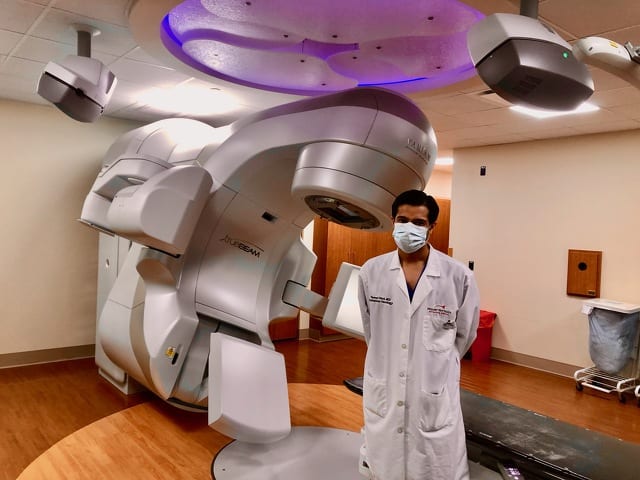
In a room at the Lance and Ellen Shaner Cancer, Patel explained the workings of the linear accelerator. The medical center has two of the machines, which are used for intensity modulated radiation treatment to deliver a customized, precise dosage of radiation conforming to the shape of the tumor while preserving healthy tissue.
It’s also fully integrated for image guided radiation therapy, stereotactic radiosurgery and stereotactic body radiation therapy.
‘With studies that have come out and the technology that we have, we’re able to deliver a high dose of radiation therapy using a lot of precision and accuracy,’ Patel said. ‘Everything its within a fixed system and it’s very precise.’
Mount Nittany also performs brachytherapy, or internal radiation therapy, in two forms. Low dose rate brachytherapy is often known as prostate seed implants, which give off a small amount of radiation over time within the body and eventually decay. High dose rate brachytherapy involves using an applicator to place a high energy radiation source inside the patient for a short period of time.
‘It is actually a much higher dose than when we do a prostate seed implant, and then that source can come back out again. It’s never permanently placed into the patient. It’s only temporary and comes back out safely into our afterloader unit,’ Patel said.
Another mode of treatment the department offers is unsealed source radiotherapy, in which radium 223 is injected into the patient’s blood and is used to treat metastatic prostate cancer and bone cancer.
Patel said his department is often exploring new technologies and advancements. 3-D printing, for example, has been helpful in creating tissue-like material that goes on a patient’s skin.
‘Sometimes we want to treat the actual skin. We used to just have this thing called Superflab and it would go on top of the skin and we’d try to get radiation dose to the skin,’ Patel said. ‘It did the job but it wouldn’t necessarily always conform very well if you’re treating something that’s not just a simple flat surface. We’ve really harnessed 3-D printing and we can print anything we want to. We can make things we never thought we could make. We used to have to do a lot more work, use a lot more tape, redo things everyday. Now we can 3D print something in under a day and we can utilize that.’
Machine learning is also beginning to assist in treatment planning.
‘That doesn’t mean machines are replacing doctors but some of the planning that we do on computers, we can harness the ability of things like machine learning and AI to develop plans quicker,’ he said.
‘For example, if I do a prostate cancer treatment for a patient on a radiation therapy plan, I’ll give my dosimetrist all the things I want to treat and don’t want to treat and she takes that and works to develop the plan. That’s the first iteration,’ he said. ‘Maybe theres something I don’t like about it, maybe the dose is too high. Then I’ll ask her to go back and work on it. With machine learning it can take all those steps out of it because it can take all the previous treatment plans you’ve done and utilize that information to give you what is going to be your best option of care.’
Offering a variety of services and finding ways to stay on the cutting edge all help to make a community cancer center a place where patients can get the care they need without having to travel far away.
‘We really try to provide the depth of what’s necessary for patients so that they don’t have to go two hours away to get a lot of these things,’ Patel said. ‘Sometimes those are the circumstances for patients; they can’t get a majority of care in their own hometown. They have to go drive back and forth. We really try to do the best job we can to give our patients the ability to stay local if they want to.’
The radiation oncology department and Mount Nittany Health are making sure that care remains available despite COVID-19.
‘I think the important message for patients is that this shouldn’t be a barrier to their care,’ Patel said. ‘I think that’s across the board in medicine but specifically in oncology because its really important for patients to move forward with things… Cancer doesn’t stop so we need to keep treating people and taking care of what they need.’