
Forensic exams and care for survivors of sexual assault require specialized training and experience, and for underserved rural areas — of which Pennsylvania has many — those expert resources often are not available.
An innovative new center at Penn State, backed by funding from the U.S. Department of Justice, is aiming to change that through the use of technology, telemedicine and trained professionals.
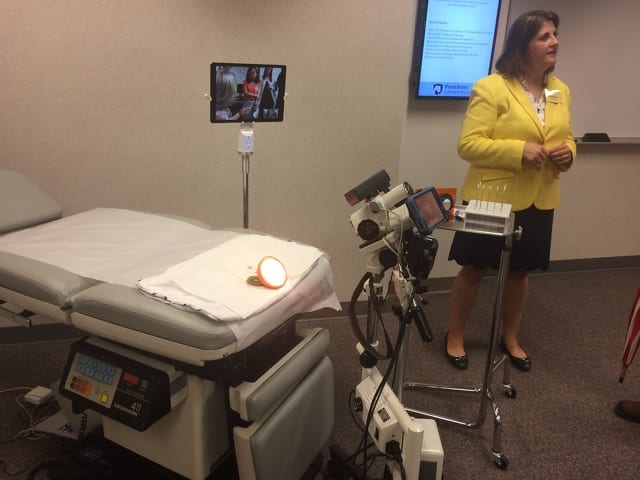
The Sexual Assault Forensic Examination and Telehealth (SAFE-T) Center received a $1.1 million grant from the Department of Justice’s Office of Victims of Crime in December. On Tuesday, project leaders opened the doors of the center’s new lab that will help improve access to forensic sexual assault care and provide mentorship and training for health professionals around the state.
Sheridan Miyamoto, assistant professor of nursing and principal investigator for the project, said the lab and center seek ‘to create a sustainable solution to enhance access to high quality forensic sexual assault care in underserved areas.“
The lab, in the Nursing Sciences Building at University Park, includes high-resolution video conferencing that can be used for live examinations, virtual reality technology and a simulation lab.
Kris Rose, deputy director of the DOJ’s Office of Victims of Crime and who has spearheaded a national telehealth program for sexual assault victims, said the goals of the project are to help clinicians, patients and law enforcement.
Victims’ first points of contact at a hospital after an assault can determine how their path will unfold, and an experience with a trained Sexual Assault Nurse Examiner (SANE) can help guide them to healing while also being more willing to participate in the criminal justice system.
‘For patients, we want them to feel like they are in good hands and empowered to make decisions that are right for them,’ Rose said. ‘We want to make sure they know resources are available to help them through after a sexual assault occurs. And we want them to feel good about the care they receive.’
For clinicians, Rose said the goal is to help build confidence and skills while retaining more trained SANEs. And for the criminal justice system, the center wants to ensure that quality of evidence is better.
‘My vision quite simply is for every hospital in this country, regardless of where it is located and regardless of where the victim is located, that they have access to expert SANE services,’ Rose said. ‘I know they SAFE-T center here at Penn State is going to do just that for sexual assault victims in Pennsylvania.’
Through the center, a team of nurses will be available at any time of day to connect remotely with hospitals. They will be able to not only guide the nurses at the hospital through the forensic exam, but also provide mentorship to help them develop skills to become experts at their local facility.
The center is working with four pilot sites to start the effort — Geisinger Lewistown, J.C. Blair Memorial Hospital in Huntingdon, Soldiers and Sailors Memorial Hospital in Wellsboro, and Penn Highlands in DuBois. A focal point of the project is developing affordable technology that can be deployed to any hospital.
‘[The lab] is actually going to function as our telehealth hub,’ Miyamoto said. ‘It will allow us to do really high quality immersive training as well as connect remotely with our pilot sites for forensic exam consultation, peer networking and ongoing education.’
Penn State’s Child Maltreatment Solutions Network, which addresses issues of abuse and neglect, is among the organizations supporting the project. Director Jennie Noll, professor of human development and family studies, stressed the important role nurses play in helping victims of sexual abuse and assault.
‘I’ve been doing this kind of work for almost 30 years and I hear story after story after story of victims and what they went through just after their abuse was disclosed,’ Noll said. ‘I don’t think many of us understand how traumatic that can be. For some victims still, even in Pennsylvania, even in Centre County, they have to travel to get these exams. To bring that home and bring that into a facility they’re comfortable in reduces that stigma, reduces that trauma and increases the chance of healing in a very profound way.’
The SAFE-T Center is also receiving support from Penn State’s Clinical and Translational Science Institute, which is developing the technology for the lab and remote sites, as well as the College of Nursing, which is the center’s home.
Pinnacle Health, the Pennsylvania Coalition Against Rape and the Pennsylvania Office of Rural Health have collaborated on the center, which has involvement from various corners of the university.
More Latest Penn State News
View all Latest Penn State News
Penn State Urges Prevention as Measles Cases Rise in Pa.
Penn State officials on Thursday urged community members to ensure they are protected against the measles as cases of the virus continue to rise across Pennsylvania and nationally. No confirmed […]

Big Ten Blood Drive Puts Penn State in Race for $1M Grant, Seeks to Boost Supply Amid Critical Shortage
Penn State is asking students, alumni and fans to donate blood as the university joins all 18 Big Ten schools in a competition that could bring a $1 million grant […]

New International Students Adjust to Happy Valley With Hearts Still Connected to Home
Each August for the last 10 years, I’ve written a column about Penn State’s newly-arrived international students. Why that emphasis, you ask? Well, to put it bluntly, our campus and […]


