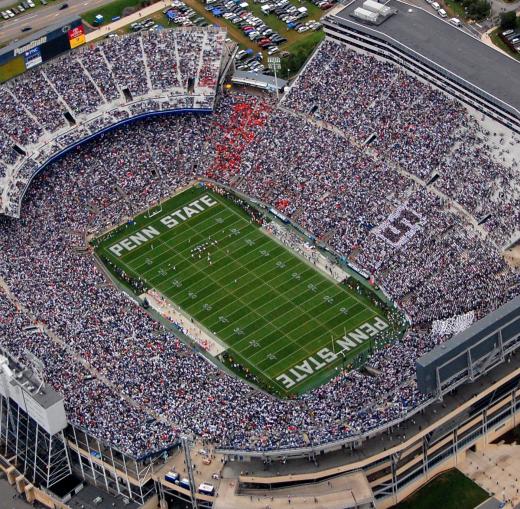
The relative success of the Seat Equity and Transfer Plan — or STEP — for Beaver Stadium appears to be ‘a very strong sign of (Penn State) fans,’ Associate Athletic Director Greg Myford said this week.
‘And we’re very appreciative of the fans’ recognizing why we need to put the program in place,’ Myford said. ‘I think it’s a sure sign of the fans’, for the most part, understanding why we need to take the step that we have to put this program in place.’
He said the measure will help Penn State remain ‘competitive and (make) sure that we’re where we all want Penn State football to be moving forward.’
The university athletics department announced the STEP program in 2009, but it won’t take effect until the 2011 football season. It will require all season-ticket holders to make minimum annual contributions to the Nittany Lion Club. Those contributions will vary by the number of stadium seats that a fan holds, and by the location of those seats.
Per-seat minimum contributions — separate from the ticket prices themselves — will range from $100 to $2,000 in 2011. Penn State has reported that the extra revenue will help pay for ever-higher athletic-program expenses, including student tuition, travel, medical care, insurance and facility improvements.
Last week, the university announced that fans, counted together, thus far have tentatively agreed to buy 93 percent of the 2010 season-ticket volume again in 2011. At least 69 percent of the season-ticket seats sold in 2010 will be retained at the same-quality level in 2011; 20 percent will be upgraded to higher-quality and -priced sections; and four percent will be downgraded to lower-quality and -priced sections, according to the university.
Myford said he didn’t immediately know what portion of 2010 season-ticket holders — that is, individuals — had not renewed their accounts, but he said the percentage is very low.
Penn State has reported that the STEP results so far have beaten expectations. Myford said the university didn’t have an exact percentage in mind as an expectation, but that peer programs at other schools, in undertaking similar steps, did not slip beneath the 80-percent ticket-retention threshold.
The university does not yet know exactly what football-revenue totals might be when STEP takes effect, Myford said. That hinges in part on the individual seats that seat-ticket holders choose later this year, he said.
On Friday, buyers displaced by several impending stadium changes — the addition of more handicapped-accessible seats and the movement of student and visitor seats — began to pick their preferred new-seat locations for 2011. That group accounts for about 10,000 total seats.
Later, in March through May, more season-ticket buyers will be able to participate in a detailed seat-selection process, according to an official timeline.
Throughout the seat-selection processes, Myford said, the university will retain the integrity of the Nittany Lion Club point system. That gives buyers with more points higher priority in choosing seats.
Earlier coverage