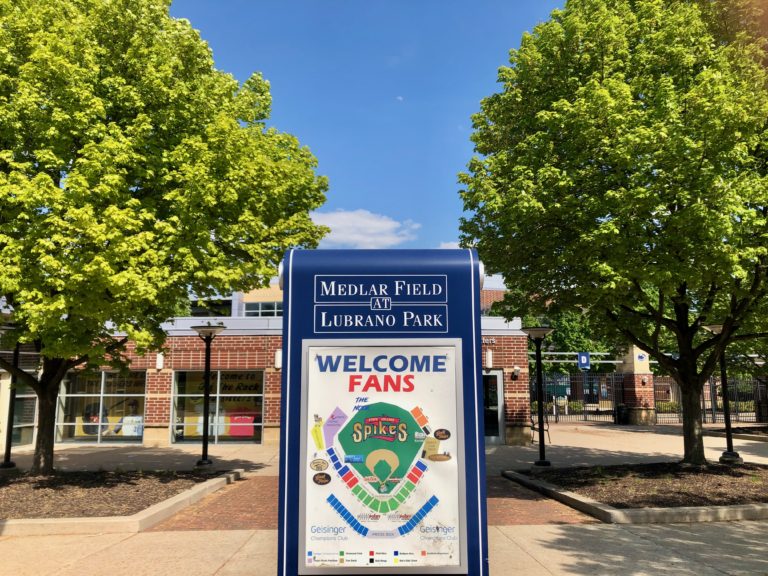
After a six-year partnership that never produced a winning season, the State College Spikes have turned to one of the major leagues most productive teams ever, the St. Louis Cardinals, in an effort to produce a winning product.
The difference, in the immortal words of Cardinals Hall of Famer Stan “The Man” Musial, says it all about the St. Louis organization and where the Spikes could be headed in the future.
“What made me sign with the Cardinals? Because they used salesmanship, the personal touch. Where others wrote, they talked. Where others waited, they acted. That early bird that got the worm must have been a Redbird.”
Next to the New York Yankees’ 27 World Championships, St. Louis has won the second-most with 11 titles.
Fans of the State College Spikes are hoping that success breeds more success. Especially after watching the Spikes, under the Pittsburgh Pirates umbrella, produce a six-year 190-259 win-loss record. The 2009 Spikes produced a .500 team that finished 38-38.
Spikes general manager Jason Dambach knows full well that a winning team on the field will produce more excitement in and around the Centre County area.
“Some markets it’s about the hot dogs, hamburgers, the fireworks, the bobbleheads,” Dambach said. “That’s important here but there’s an appetite here for a winning product. The one year that we were somewhat competitive and we had a winning record (39-36) was 2006 when we were affiliated with St. Louis. We just thought that it was time to make this change.
“The Cardinals were tremendous partners of ours,” added Dambach. “They realized early on that we had a geographic affiliation with the Pittsburgh Pirates and that we were going to make that move after that initial year. As the talks went on and the dream became a reality in State College that it made perfect sense, synergy wise for the Spikes to be a Pirates’ affiliate.
“We know that there are not an overwhelming number of St. Louis Cardinals fans here in Centre Region,” explained Dambach. “But we do know that the Cardinals are one of those true time-tested brands in baseball. Like the Yankees or the Dodgers and are absolutely one of those names that people appreciate and know that the Cardinals are going to do things the right way.”
Dambach joined the State College Spikes in January 2009, becoming just the second general manager in club history. He added the role of vice president in January 2012 and senior vice president that October. He was also selected as the New York-Penn League’s Executive of the Year for 2012.
After years of losing, it was time to make a move.
According to St. Louis Cardinals Director of Minor League Operations John Vuch, the organization acted quickly.
“We were permitted by Major League Baseball rules to begin calling unaffiliated minor league franchises at 12:01 a.m. on Sunday, Sept. 16,” explained Vuch. “Due to the Cardinals extreme interest in returning to State College, I texted Chuck Greenberg [Spikes Chairman and Managing Partner] at 12:01 a.m. to see if he was still awake and interested in discussing the possibility of the Cardinals and State College getting back together. He immediately replied back via text and I then called him right away after receiving his reply.”
The Cardinals and Spikes organizations wasted little time in completing the deal.
“The way it works is that a few weeks earlier, [per MLB rules] we filed our notice to terminate our Player Development Contract with Batavia in order to see what other New York-Penn League affiliates might become available,” said Vuch. “Likewise, State College and Jamestown also filed for separation from their MLB affiliates. After the termination process, teams and affiliates can begin discussions on September 16, and then pair off with their desired partners to sign a new Player Development Contract with each other.
“Due to the late time of the call, I was only one on the phone on behalf the Cardinals,” said Vuch. “We began talking at 12:01, and I’d say we had a verbal agreement in place within 15-20 minutes.
“It didn’t take long on our end at all, as we had really enjoyed our previous stay in State College,” explained Vuch. “Since our 2012 Batavia coaching staff confirmed that the operations in State College were still being run in a first-class manner as it had been in our prior stint, we knew from the outset that this was the place we wanted to be. Fortunately for us, Chuck and Jason felt the same way, so we were both able to move quickly to make it happen. I ended up flying to State College a few days later to officially sign the new PDC and have our press conference, but the actual “negotiation” on the 16th was extremely brief as both sides felt it was an ideal fit.”
Vuch is in his 26th season in Baseball Operations and his 35th overall with the Cardinals. He held the title of Farm Director from September 2010 through the 2012 seasons, and during that time oversaw Championships for three teams [Quad Cities (A) and Johnson City (R) in 2011, Springfield (AA) in 2012]. The championships in Quad Cities and Johnson City in 2011 marked the first time since 1994 multiple Cardinals minor league affiliates won league championships, and the 2012 Springfield Cardinals team was recognized as the Minor League Team of the Year.
“Early on it became very clear to us that a affiliation with any particular major league organization was not as critical as we once thought,” said Dambach. “We are Spikes fans. We aren’t Pirates fans, or Cardinals fans or Yankees, Mets, Dodgers fans, whatever we are State College Spikes fans. The brand has carved out our niche in this market, kids that were six years old when they first came to Medlar Field for a Spikes game are now teenagers. Teenagers are now young adults with maybe a young child so this becomes generational so it’s not about who you are affiliated with, it’s about making sure the experience in coming to the ballpark for a Spikes game only gets better and continues to grow.”
Despite what some may think, the Pittsburgh Pirates and the St. Louis Cardinals really don’t have much input of the day-to-day operations of the St. College Spikes.
“We really have virtually nothing to do with the Spikes actual operations,” stated Vuch.
“They do a tremendous job operating their business, and they are not owned by the Cardinals. We have the standard MLB/Minor League Baseball Player Development Contract in place with them, which spells out exactly what we’re responsible for (providing the players, paying the player salaries, meal money, coaching staff, etc) and what they are responsible (travel during the season, percentages of bats and balls, etc).
“All of the various responsibilities are spelled out by MLB and Minor League Baseball,” explained Vuch. “And teams are not allowed to change those responsibilities in an effort to make themselves more attractive to a prospective partner. For example, we can’t promise to pay for all of the bats and balls, and likewise the Spikes can’t promise to pay for players. Each sides responsibilities are specified in the PDC, which is why it is frequently topics such as facilities, personal relationships, etc, that play as much of a role in making this type of decision as anything.”
So what is the role of the St. Louis organization in all of the changes that need to be made?
“We really don’t make a lot of changes, as we will simply send our players to State College this year rather than Batavia,” stated Vuch. “Obviously, there are some equipment changes and things like that, but from a planning perspective, our preparation is very similar to how we would prepare for a season at Batavia. As far as actually ‘becoming part of the Spikes organization’, everyone associated with the Spikes has been incredibly welcoming to us and they seem to share our excitement about the upcoming season.”
And with any major corporate deals, there are always good and bad decisions that are made in completing a merger.
“The good points include the outstanding facilities that State College offers, as well as the tremendous group of people working with the Spikes,” stated Vuch. “We have a great deal of comfort with them and they’ve been great to work with so far.
“As far as any kind of bad point, the only negative was saying goodbye to the Batavia community and the Muckdogs front office,” added Vuch. “We enjoyed our time in Batavia, and I can’t emphasize enough that our decision to come to State College had absolutely nothing to do with any dissatisfaction with the way we were treated there. But my responsibility is to look out for the best interests of the Cardinals, and I can honestly say that of the franchises that were open to us at the end of the 2012 season, State College was the only one that we would have left Batavia for.”
“We’ll have a lot of communication in terms of player movement, transactions, having our coaching staff accessible to the Spikes front office if they are needed for anything involving our players,” explained Vuch. “We will talk frequently and trade emails, but the Spikes really handle their own day-to-day operations, and we try to do whatever we can to be a good partner with them.
“We’re optimistic that our relationship will be stronger than ever five years from now, with both the Spikes and the Cardinals continuing to have a lot of success.”
“Due to the constantly changing nature of minor league rosters, we can never promise or guarantee on-field success, but we do always make an effort to provide a competitive club, explained Vuch of the Cardinals organization involvement. “There’s a benefit from a development standpoint in having a team doing the things necessary to play winning baseball, so hopefully the style of play our players and coaching staff bring will be attractive to the fans and cause even more of them to want to come out to the ballpark. I also think it’s important for our players and staff to represent both the Cardinals and the Spikes both on and off the field, and doing a good job in those areas can help to solidify the bond between the team and the community.”