
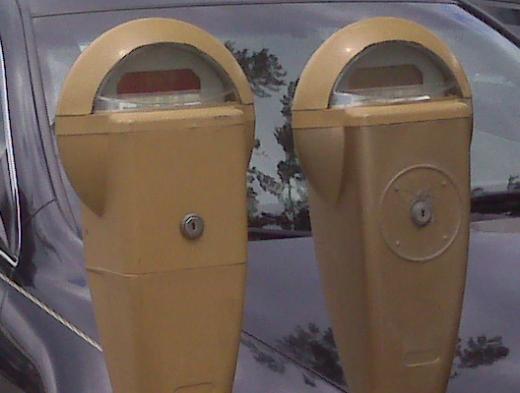
Workers are installing wireless sensors at 50 parallel spots along College Avenue this month, part of a borough effort to better analyze downtown State College parking patterns, parking Manager Charles DeBow said.
He said the new parking sensors are being installed — at no charge to the borough — by StreetSmart Technology, a relatively new company based in Georgia. The arrangement will give StreetSmart some public exposure, and the borough, in turn, will receive a 90-day trial and extensive data on its downtown parking use, DeBow said.
That data will be key in helping the borough and downtown leaders understand how much turnover the parking spaces see after 6 p.m., he said. DeBow said leaders also will monitor to see what portions of parking spaces are occupied at different times of day.
Ideally, he said, he’d like to see an average of 85 percent occupancy in the area being studied — the south side of College Avenue between Heister and Burrowes streets. An 85 percent occupancy level ensures steady street-parking availability for downtown motorists, DeBow has said.
But ‘we are not going to change our enforcement patterns, behaviors, anything along those lines’ during the 90-day trial-and-study period, expected to begin in April, he said. DeBow said the sensors, connected via a wireless network to borough computers, will identify how long cars stay in each space. The devices will identify broken meters immediately, too.
State College has never before been able to collect such comprehensive, detailed information on parking-spot use in the downtown, DeBow said.
‘It very clearly gives me data that I would not have the ability to get if I was not using this technology,’ he said.
Those usage specifics, DeBow went on, will be key in informing Parking Department policy suggestions for future downtown enforcement.
Last year, he tentatively recommended that on-street meter-enforcement hours could be extended until 10 p.m. on Mondays, Tuesdays, Wednesday, Fridays and Saturdays. He also tentatively recommended that chronic parking offenders could face progressively higher fines.
Both measures would be meant to improve the availability of on-street and surface-lot spaces, which appears to decline dramatically in the evening hours, DeBow has said. (Details of his earlier tentative suggestions are included in this earlier report.)
The Borough Council has yet to vote on any such parking-policy changes, and downtown business owners have been divided over how the borough should proceed, Downtown Improvement District (DID) Executive Director Jody Alessandrine has said.
DeBow is hopeful that data yielded from the new sensors will inject new insights into those downtown conversations, he said. In consultation with the DID, he would like to formalize some parking-enforcement recommendations before the Borough Council by July, he said.
‘This technology is one step in the direction of having the ability to pay by cell phone’ for parking, DeBow said. ‘ … This is the parking industry catching up to technology.’
Earlier coverage
More Local News
View all Local News
State College Teen Turns Passion for Card Games Into New Downtown State College Business
Just over a year after graduating from State College Area High School, a 19-year-old entrepreneur is preparing to open a new trading card, tabletop and retro gaming store in downtown […]
State College Transitioning to New Official Digital Parking Payment Platform
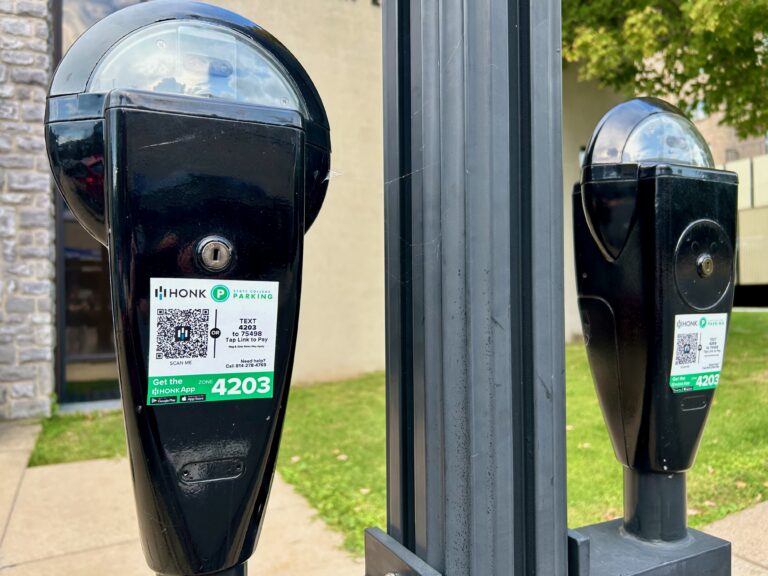
State College will officially transition to HONK Mobile as the borough’s official digital parking payment system on Tuesday, Sept. 1. Parking sessions can be purchased via the HONK website, the […]

Press Forward Survey Highlights Value of Local Journalism
Press Forward PA Wilds unveiled the results of a yearlong research project that gathered feedback from more than 2,000 residents across nine counties.


