
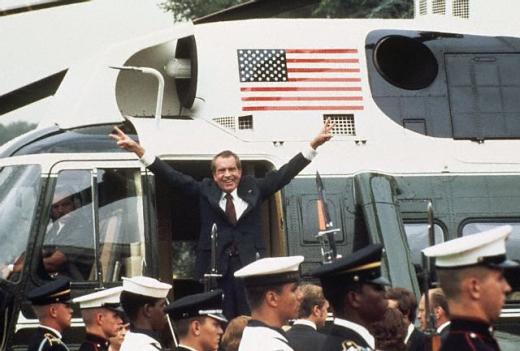
Happy Watergate Day! Here is the opening sentence of the Washington Post’s account of what happened at a certain ‘plush’ hotel-office building 39 years ago today:
Five men, one of whom said he is a former employee of the Central Intelligence Agency, were arrested at 2:30 a.m. yesterday in what authorities described as an elaborate plot to bug the offices of the Democratic National Committee here.
The byline belonged to – surprise! – Al Lewis, the Post’s longtime police reporter. Bob Woodward and Carl Bernstein were listed at the bottom of the story as contributors, along with six other reporters, including an intern named Tim O’Brien. A quick search reveals that yes, it’s the same Tim O’Brien who went on to write ‘The Things They Carried’ and other books.
The fourth paragraph of the story addresses the key question:
There was no immediate explanation as to why the five suspects would want to bug the Democratic National Committee offices or whether or not they were working for any other individuals or organizations.
Herblock, the Post’s political cartoonist, had an inkling of who these other individuals or organizations might be. Five days after the break-in, he drew an investigator-with-magnifying glass mulling a set of footprints leading from the White House. ‘Strange,’ he says, ‘they all seem to have some connection to this place.’
Over the next two years, as Woodward and Bernstein and other reporters tracked the footprints ever closer to the White House, Herblock depicted Nixon walking on mud prior to his re-election in November 1972; wrapping himself in an American flag labeled ‘National Security Blanket’hourglasssandbagging as a tidal wave of evidence is about to wash over him.
Then, on Aug. 8, 1974, he drew Nixon’s hand signing his letter of resignation.
I talked to Bob Woodward about Watergate last week as part of the oral history project I’m doing about the life and times of Herblock. You’d think maybe Woodward would be tired of rehashing Watergate by now, but I didn’t get that sense at all. This was the turning point in his career, a turning point in American history and perhaps the high point of what appears to have been the golden age of American journalism. One doesn’t get tired of reliving an experience like that.
And yet, when I told my beginning journalism students the night before that I was headed for Washington to interview Bob Woodward, for the first time in my teaching career none of them knew who he was.
‘You know about Watergate, right?’ I said.
Silence. Then, ‘Wasn’t that Reagan?’
I relayed this sorry tale to Woodward as we made our way through the labyrinthine halls of the Library of Congress after our chat. He was unperturbed. ‘That’s why they’re in college,’ he said. ‘To learn.’
Fair enough. So why is it important that journalism students know who Bob Woodward is and what Watergate was? As one who is trying to teach these students how to write news stories this summer, I can answer in purely practical terms.
To write a news story you first have to rank the facts in their order of importance. To do that, you have to understand why the news matters. That gets us to the role of journalism in American society, and one of the best ways to grasp the role of journalism in American society is to look at those moments when journalism has had its greatest impact. Which gets us to Watergate.
The Watergate story began as a cop story and in many ways it was always a cop story, albeit one that played out on a far larger stage and for much larger stakes. Like a hit-and-run driver, Nixon committed a crime and then tried to escape responsibility for it. We care because we as citizens empower drivers by agreeing to allow the state to grant them licenses, just as we empower the candidate who gets the most votes (2000 election excepted) to serve as president.
If drivers or presidents abuse their power, or exercise it irresponsibly, we want the state, acting on our behalf, to curb their power, by revoking the driver’s license and the president’s mandate to govern.
Sometimes, the state investigates and the news media keep us apprised. Sometimes, as with Watergate, the news media investigate and the state follows suit.
During my interview with Woodward, I said something about Herblock having attacked Nixon in his cartoons. Woodward corrected me. He didn’t attack Nixon, he said. He exposed Nixon.
Thus exposed, Nixon lost his mandate to govern. But he didn’t then send his goons to shut down the Post or his army to stifle dissent, the way Qaddafi and Assad and company have this spring. He couldn’t.
Thus we celebrate Watergate as the moment when the American system – separation of powers and a watchdog press – functioned the way it is supposed to.
More Columns
View all Columns
Inside/Outside State College: Excellent Restaurants Outside of Downtown
In this column, I’ve expressed chagrin about the lack of higher-end restaurants in a downtown as dynamic as State College. While that’s true, there is good news outside of downtown.
Local Historia: Bellefonte’s Legacy of Innovation
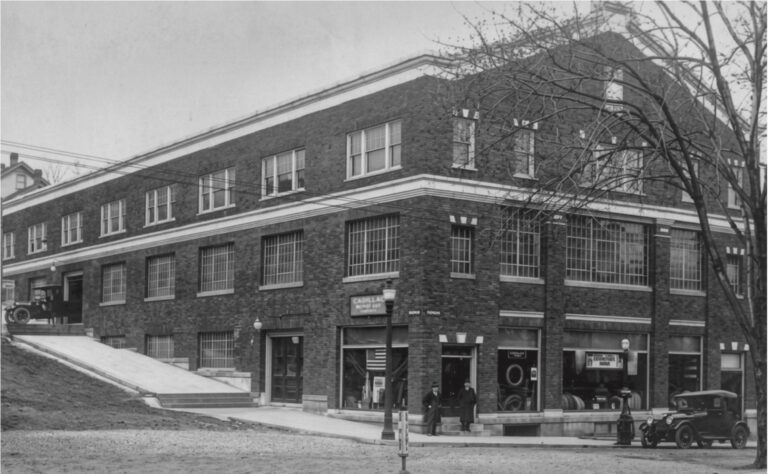
Pioneering architect Anna Wagner Keichline's Cadillac Building combined showroom space, repair facilities and offices under one roof, reflecting both the practical demands of the automobile age and the spirit of innovation that characterized Bellefonte in the early 20th century.

Battista: The Retiree’s Adventures Continue…
Buckle up, baby, ‘cause we’re back on the road again! Nine states in 27 days of driving and flying, and dealing with torrential rains and tornado warnings in Pennsylvania, and […]


