
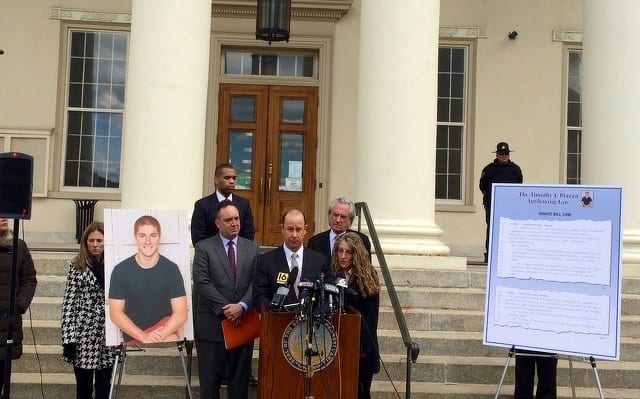
An overhaul to Pennsylvania’s anti-hazing law introduced on Friday by Pennsylvania Senate Majority Leader Jake Corman has already taken a big step forward.
The state Senate Judiciary Committee on Tuesday unanimously approved the Timothy J. Piazza Anti-Hazing Law, named after the 19-year-old Penn State sophomore who died in February 2017 from fatal injuries sustained after falling multiple times during an alcohol-fueled pledge initiation at the now-banned Beta Theta Pi fraternity. Prosecutors have described the case as hazing.
After passing committee, Senate Bill 1090 will now move to the full Senate.
Corman has been working with Piazza’s parents, Jim and Evelyn, as well as Penn State officials and others since last year to develop the legislation, a comprehensive rewrite of the state’s anti-hazing law that creates new tiers and strong penalties.
“Working with the Piazza family, prosecutors, universities and others, we have developed wide-ranging anti-hazing legislation that focuses at prevention, enforcement and transparency,” Corman said in a statement. “With this proposal, students will have the tools they need to make informed choices about the groups they consider joining as well as safeguards so they can make good decisions in times of distress.”
Corman, the Piazzas and Penn State President Eric Barron all said the legislation is a model for the rest of the nation and they hoped it would land on Gov. Tom Wolf’s desk for approval soon.
Currently, hazing is only classified as second-degree misdemeanor in Pennsylvania. Senate Bill 1090 was introduced in the legislature on Friday and under the proposed law, hazing that results in bodily injury to a student remains a misdemeanor. However, hazing that results in serious bodily injury or death is classified as aggravated hazing, a third-degree felony.
The new law also would add summary offenses for hazing that does not result in injury.
New organizational and institutional hazing provisions also are included in the legislation.
The organizational hazing offense is for fraternities, sororities or clubs that knowingly or recklessly allow hazing or aggravated hazing. Penalties include fines or forfeiture of property.
Institutional hazing similarly would hold accountable colleges, universities and other institutions that knowingly or recklessly allow hazing or aggravated hazing to occur. They would be subject to fines ranging from $5,000 to $15,000 per offense, depending on whether the incident was hazing or aggravated hazing.
The legislation includes a safe harbor clause for student who call for emergency help for an individual who has been hazed. Similar to the state’s drug overdose immunity law, the person who calls for help and waits with the victim for emergency personnel to arrive would be immune from prosecution for hazing and underage drinking.
Corman, who noted that there were four hazing deaths at fraternities in the United States in 2017, thanked Senate Judiciary Chair Stewart Greenleaf for moving the bill through swiftly.
“The bill has been carefully crafted because we want this to be a model for changing anti-hazing laws nationwide,” Corman said. “My intent with this legislation is clear – to prevent death or serious injury due to hazing so that families, such as Tim’s, never experience tragedies like this ever again.”
More Latest Penn State News
View all Latest Penn State News
Penn State Urges Prevention as Measles Cases Rise in Pa.
Penn State officials on Thursday urged community members to ensure they are protected against the measles as cases of the virus continue to rise across Pennsylvania and nationally. No confirmed […]

Big Ten Blood Drive Puts Penn State in Race for $1M Grant, Seeks to Boost Supply Amid Critical Shortage
Penn State is asking students, alumni and fans to donate blood as the university joins all 18 Big Ten schools in a competition that could bring a $1 million grant […]

New International Students Adjust to Happy Valley With Hearts Still Connected to Home
Each August for the last 10 years, I’ve written a column about Penn State’s newly-arrived international students. Why that emphasis, you ask? Well, to put it bluntly, our campus and […]


