I come from a long line of military service on both sides of my family, at least as far back as the Revolutionary War. With the stories of both my grandfathers’ service in World War II ringing in my ears, it is no wonder that I pursued a career in the Army. Grandfather Max Hartswick fought in the Pacific theater with the fabled Americal Division. Grandfather Malcolm Hummel landed at Normandy Beach with the 28th Infantry Division and continued his trek through the European theater. My childhood set me up for the military.
As an only child in a joint-custody divorce, there was no getting away with anything as far as my parents were concerned. Both my mother, Morgen Hummel, and my father, Sean Hartswick, had high expectations for me to succeed academically and physically.
Traveling between households, I learned early on that there was nowhere to hide and no excuses for any behavior. Accountability and follow-through were essential to my childhood.
From this seemingly chaotic upbringing came my flexibility, adaptability, and some excellent improvisational talent — a great skill set for a soldier. I joined the Army at the age 17 with my parents’ consent. I was an unruly child for my parents, an average student and a pretty good athlete in school, and I had a facade of a “perfect angel” to the outside world — another good skill set for the Army. A good soldier and warrior gets along with whom he serves, but it always pays to be defiant in the face of impossible odds. Especially when facing death.
May 14, 2013, started out like any day on deployment on our isolated Combat Outpost (COP) in our remote region of Afghanistan. I had been in the Army a little more than three years and was on my second combat deployment. I was 22 years old as an infantry company’s senior medic. I was responsible for the professional development of four platoon medics and the medical well-being of the entire company of 80 men.
Compared to my previous deployment to Iraq in 2011, this was a different place entirely. That is to say, in 2011, Iraq wasn’t the active engagement that it was in previous years and that Afghanistan was and still is today. As most people will tell you, 90 percent of a deployment is sheer mind-numbing boredom. The other 10 percent can be simultaneously awesome and terrifying — not to mention life-changing.
For the most part, this was a routine deployment: manning the aid station of our COP, dispensing meds to soldiers, keeping tabs on soldiers’ health, and treating the occasional local national. The men of A Co, 3-41 Infantry had become my family. Like any family, there are times of hardship, conflict, and strife. But your family loves you anyway. In this brotherhood, we were willing to fight and die for each other. Especially on May 14, the day we fought to keep each other alive.
One of our dismounted (on foot) patrols ended up in an IED (improvised explosive device)-related ambush in a small village within the Zhari District of Afghanistan. Initially, I was on guard duty at the COP when I heard over the radio that our patrol was being ambushed. I quickly gathered my gear and weapon, grabbed my designated replacement for the guard tower, and jumped on the nearest truck heading out with our QRF (Quick Reaction Force). When I arrived on the scene with the QRF, three of my brothers had been killed already, including my soldier, a platoon medic, Specialist Cody Towse. The other two were Specialist Mitch Daehling and Specialist William Gilbert. Between the ensuing chaos and gore, we were able to set up a Casualty Collection Point to treat the injured and gather the fallen.
While waiting for the EOD team (Explosive Ordnance Disposal, “bomb squad”) to start its interrogation of an IED to clear a path, the team leader, SFC Jeff Baker, reassured me “we are gonna save our brothers.” He stepped away to defuse an IED and disappeared in a cloud of dust and shrapnel — the blast floored me and the guys nearby. The platoon leader (PL) helped me to my feet, refocused, and reassured me that we would treat our wounded and retrieve our fallen.
We got to work. Concerned for Baker’s well-being — either alive or dead — I had to look for him, telling everyone, “I’m going the [expletive] down there!” and moved toward the river, where he was assumed to be. As I ran down the path to the river, I “zigged” when I should have “zagged” and stepped on an IED. The blast threw me in the air and I landed on my stomach.
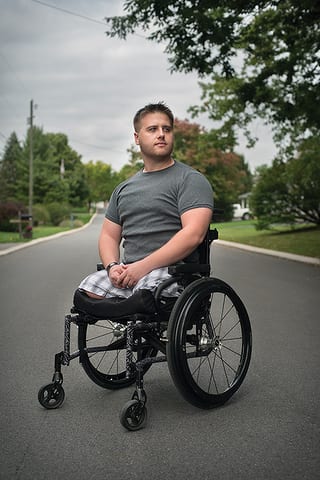
Dazed but still conscious, I struggled to stand up. The PL saw my condition and shouted to me to stay down, but I couldn’t feel any pain and thought myself invincible. I flipped myself over, only to realize that I was definitely not invincible and that my legs had become hamburger meat. I thought I was going to die, but then realized I didn’t have to. Tearing the tourniquets from my vest and starting to wrap my thigh, I realized the blood on my hands was from my missing right index finger and partially severed thumb. I struggled to tourniquet myself when the PL approached and said, “Doc, tell me what to do.” I told him, “tourniquets high and tight,” an easy phrase for us to remember, as it also is a reference to our military haircuts. We had drilled so much on tourniquets that he knew what to do. He finished applying my tourniquets and comforted me, exuding a confidence that made me feel I was in good hands and I was going to be okay.
Coincidentally, Dustoff 68, a medevac helicopter, had been on station to retrieve the original wounded from the initial attack. The crew had made the courageous decision to land in that IED minefield, which made our rescue almost instantaneous. Dustoff 68 earned the coveted Silver Star and Medevac of the Year for 2013.
By the end of the first week after my injuries, I was stabilized and flown back to the United States to continue my treatment at Walter Reed National Military Medical Center in Bethesda, Md. The first seven weeks back on American soil are fuzzy at best. I had 11 surgeries in the first two months and a total of 21 surgeries altogether.
Rehabilitation at Walter Reed is a blur. Physical therapy after traumatic amputation of both legs above the knee is severe, to say the least. Unlike any other fitness routine, the goal isn’t “stronger hammies” or “toned quads” — mine are gone. This was completely different and totally trying. Sure, I had my share of physical activity growing up. It was hard to maintain my interest in computer and video gaming as a kid with parents like mine. They were role models of physical activity. It was tough keeping up with them, but I did. My main sport became wrestling. So between my wrestling background and various military training, including lots of ruck marches and running, I became an adept athlete, and I learned how to endure. I learned the meaning of “grit.”
Between the surgeries and the heavy medication, my first trip to a physical-therapy appointment was like a DUI drive in a clown car. Even with my parents and medical personnel guiding me in my (then) electric wheelchair, I bounced off hospital walls and ran into doors. My first attempt to move onto the PT table was hilarious. Jumbles of IV tubes, wound-vac drains, and good old imbalance thwarted me at first. Having lost one-third of my body weight, I was weak and needed to regain strength throughout my core and upper body before ever having the power I would need to move prosthetic legs. The crew at Walter Reed were the most caring, compassionate medical professionals I have ever met. Their warmth and firm coaching pushed me and helped me to push myself in new ways. I found strength in their and my parents’ support. I grew stronger and my mind cleared every day. After seven weeks of in-patient stay, I was moved to the on-base housing for wounded service members at Walter Reed.
I continued my rehab there for almost another two years. Over time, after a wide variety of exercises, I regained self-confidence as the staff at Walter Reed put me through the paces. Rehab with other wounded service members nearby is nothing like anything you can imagine. There are countless variations of the battlefield injury, some you can see and some you cannot. Missing hands, feet, hands and feet, above the knee and below the knee amputations, blindness, deafness, traumatic brain injuries — they’re all there; men and women of all branches of the US military and, occasionally, soldiers from allied nations, too.
There’s no avoiding the usual cross-service rivalry, as shown by the shouts of encouragement and coaching. There are call-outs and challenges from everyone in the gym. Personal goals are met in every step, or rep, or race around the track. We recover our strength, our sense of self-reliance, and our confidence in our revised bodies in the midst of the mayhem of the PT facility. I know I did.
I grew strong again in the Army. Still a soldier, my new duty was to recover. With the unconditional support of my parents and the expertise of the staff and volunteers at Walter Reed, they got me through the early days of being an amputee and helped get me on the way to a “new normal” with a wheelchair and prosthetics.
I medically retired from the Army in April 2015, with an honorable discharge, and moved home to the State College area. I work for Techline Technologies, instructing battlefield medicine to law enforcement, EMS, fire, and military personnel. It’s a traveling job. I especially enjoy it because I have a vehicle with hand controls that provide a great deal of independence, which is key to my life. I plan to attend Penn State in the near future.
This story is incomplete without addressing Post Traumatic Stress Disorder (PTSD) and veteran suicide. Yes, a lot of battlefield stories include PTSD. Just because someone suffers a traumatic brain injury, which I did, doesn’t mean you’re going to have PTSD. It’s a matter of perspective, treatment, and mental outlook, as well as having a strong support group there to catch you when you fall. Sure, my injuries and the events of that day will always run through my mind. I miss my four brothers and think of them often.
Of course I have bad memories. I’m not saying PTSD isn’t real, I’m saying that it can be overcome. I’m also saying a lot of people also claim to have PTSD and actually don’t or suffer from something else entirely. This happens because of its broad definition that needs to be revised so people can get proper treatment. False claims and/or misdiagnosis take help and resources away from those who need them the most. Sadly, many veterans don’t seek or receive the help they need. As a result, 22 veterans commit suicide every day, according to a Department of Veterans Affairs statistic in 2013. Every day. That’s 22 too many. Reach out to your friends and community. Get them the help they need, be the listening ear, the shoulder to cry on. Get them to a professional who can help.
Fellow veterans, there are no excuses, we leave no one behind. Take any opportunity you can to help and don’t stand idly by wondering what to do. Take action. This is my call to help out, to put an end to veteran suicide and to put an end to the overuse and misuse of the “catchall” PTSD.