
UPDATED @ 11 p.m. Monday: Attorney says that ‘I don’t know who did’ the vandalism. Details below.
Less than a week before its planned sale to Penn State, the former Phi Delta Theta fraternity house, 240 N. Burrowes Road, has been thoroughly vandalized.
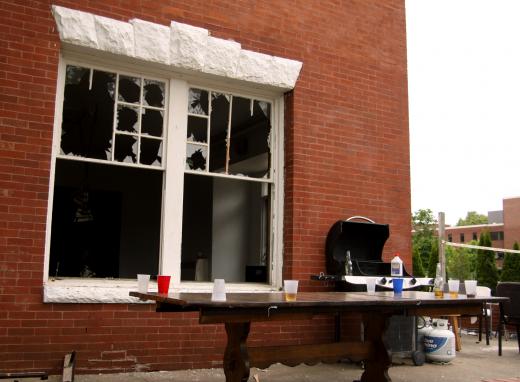
Workers and students arrived on the University Park campus this morning to find many windows smashed out of the century-old brick residence. The front door stood wide open, and rudimentary graffiti — including an image of an anatomically correct woman — marked the interior.
A fixture that appeared to be a chandelier had been ripped from a first-floor ceiling. Beer bottles and cans lined an outdoor patio area. Other trash was left strewn about the interior and the lawns. A large kitchen knife lay in the grass near a sandy volleyball court.
Two residents of the house, approached by a reporter early this afternoon, said they were busy moving out and could not talk. This morning, a contractor said a fraternity alumni association had hired him to board up the windows and seal off the building.
The local Phi Delta Theta Alumni Corporation had been renting the house to members of Tau Delta Phi in recent months. But ‘I don’t know who did it (the vandalism),’ said attorney Bernard Cantorna, who has represented the Alumni Corporation.
‘We’re in the process of dealing with’ the situation, he said.
An observer in the area said that residents of the home were responsible for the damage. The observer, who did not want to be named, said the vandalism happened over the weekend and appeared to be very deliberate.
‘We have not been inside yet to estimate the extent of damages because we don’t own it,’ Penn State spokeswoman Lisa Powers said. ‘But judging from the outside, it’s obviously a train wreck.’
University trustees agreed in March to buy the fraternity property, including the house, from the Phi Delta Theta Alumni Corporation for $1.75 million. Powers said the transaction is scheduled to be finalized on Friday.
It marks the end of a long legal struggle between the university and former residents at the house. The General Council of the international Phi Delta Theta organization suspended the Penn State chapter in December 2007 after repeated alcohol violations, according to a university report.
But house occupants continued to host parties, and the international Phi Delta Theta organization officially expelled former local members from the fraternity in March 2008, Penn State reported.
Because the fraternity had no national recognition, the university argued that it could no longer recognize the organization, either. In November 2008, Penn State filed a lawsuit to buy the property and the house back from the Alumni Corporation.
Penn State cited an original agreement between Phi Delta Theta and the university, signed in 1905. According to that document, the university provided Phi Delta Theta with the land for the fraternity, but retained the right to buy back the property if the fraternity were to dissolve.
The legal action was dropped when Penn State reached an agreement with the fraternity group, though some students continued to live in the house in violation of borough code and university policy, the university said. At last count in April 2009, nearly 25 students were still living there, according to Penn State.
The university had given the remaining occupants until the end of the spring 2010 semester to vacate the house. Final-exams week ended May 7.
Powers said Penn State has not finalized any plans for the house.
‘I think we were waiting to get inside the house and assess what sort of condition it was in from a safety standpoint and a livability standpoint,’ she said. ‘Right now, we don’t have any plans on the books, but the idea was to close on the property and go in and take a look. Now I guess we’ll have much more to see.’
Because the Alumni Corporation remains, at this point, the owner of the property, any punishments for the vandalism would need to come from the corporation, Powers said.
She said a university vice president may have already discussed the vandalism with some residents of the house.
‘No one seems to know exactly how this occurred,’ she said. ‘There’s lots of finger-pointing going on. Let’s just say no one is taking responsibility for it at this point.’
More Local News
View all Local News
Mojo Fest Returns to Tussey Mountain With Music, Vintage Vendors and Student Effort
The Centre Region has plenty of festivities that bring people together, and this spring, Mojo Happy Valley Music Festival added another with a day built around live music. Mojo Fest […]

Downtown State College Celebrates 25th Annual Fall Fest
Community members filled South Allen Street on a picturesque autumn day Saturday for the 25th annual Downtown State College Fall Fest. Hosted by the Downtown State College Improvement District, the […]

Shapiro Visits Centre County to Announce Major Funding for High-Speed Internet Expansion
Gov. Josh Shapiro joined state and local officials at Bald Eagle Area Middle and High School on Friday to announced $448 million in grants awarded across the commonwealth to expand […]


