
This story originally appeared in The Centre County Gazette.
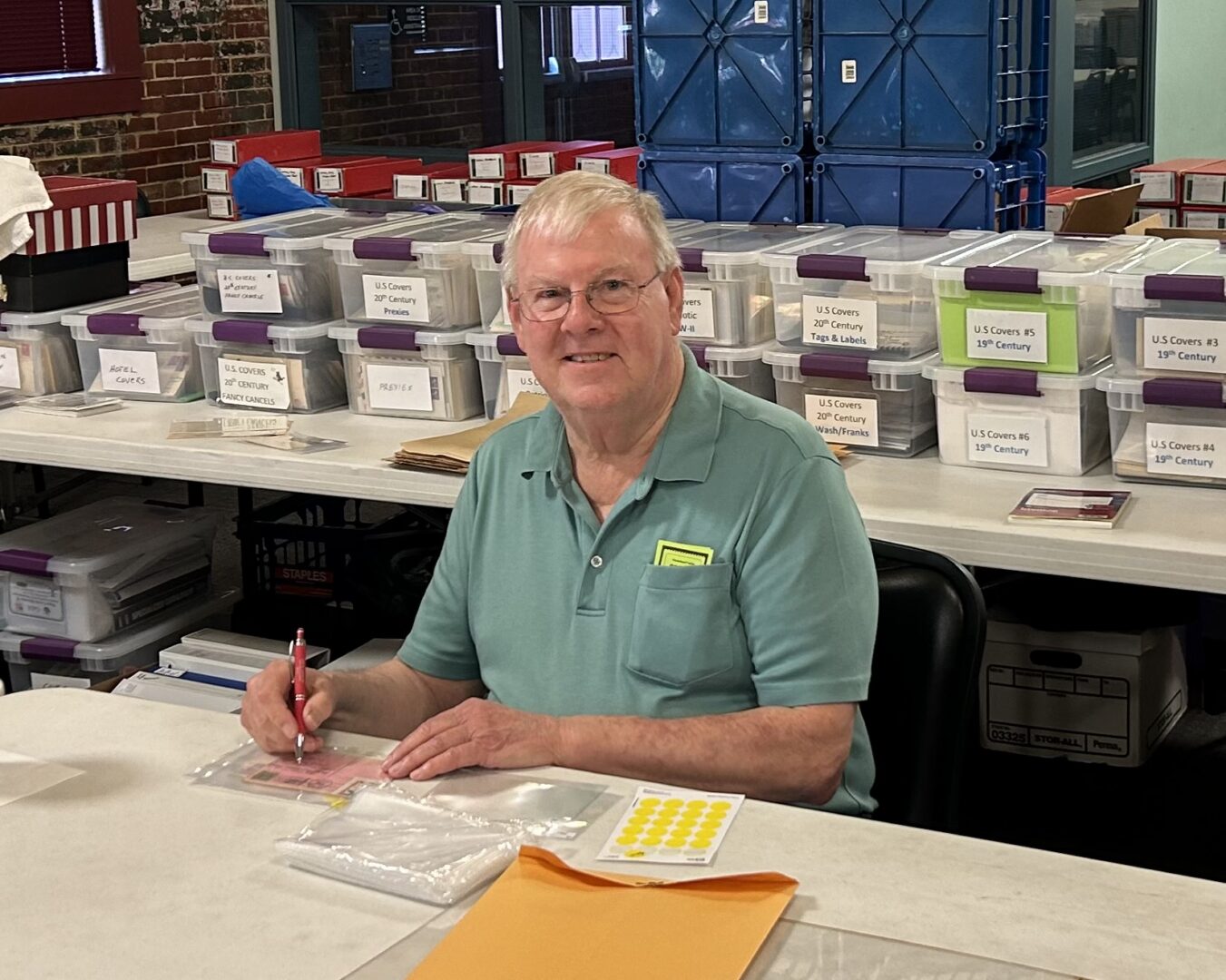
BELLEFONTE — For more than 70 years, Gerald Robbins has been collecting stamps.
Beginning at only 8 years old, the local philatelist — the fancy word to describe one who studies, collects and appreciates postage stamps and postal history — is now president of the local Mount Nittany Philatelic Society and a life member of both the American Philatelic Society and the American Philatelic Research Library.
Bellefonte is the home of the American Philatelic Center, which is the APS headquarters.
The Bellefonte club dates to 1946 in State College, according to Robbins. The club is APS Chapter 199 and APS Life Chapter 22.
“There were mentions of meetings for stamp collectors in the Penn State Collegian in 1912 and 1913, and the Nittany Philatelic Club in 1933, all in State College” Robbins explained. “There were collectors in Bellefonte in the 1880s, but other than several of them joining the APS, there doesn’t seem to have been a local organized group.”
There are currently about 35 members in the local group including Robbins — and they are hosting their annual stamp show at the APC, called SCOPEX, where collectors exhibit their stamps and covers, and stamp dealers sell their wares, including some rare treasures.
This year, SCOPEX will be held June 20-21 at 100 Match Factory Place, Bellefonte. The Saturday show is from 10 a.m. to 5 p.m. and on Sunday from 10 a.m. to 4 p.m. Admission and parking is free
The APS and APRL will be co-hosting an Open House event on the first day of SCOPEX with stamp and antique evaluations, stamp crafts and activities, and tours of the APC.
Robbins was a child growing up in Michigan when he started collecting stamps. He said sports and girls got in the way before he restarted his interest in stamps when he was 25 years old and in the U.S. Air Force, stationed in California.
“My folks purchased an orange bag, the ‘Big Bag of Worldwide Stamps for $1’ with about 1,000 stamps from H.E Harris company in Boston. My friends and I would sit in the living room on the floor and trade duplicates,” Robbins recalled. “I put my album away during my teen years and restarted when I was in the Air Force.
“I met a local stamp dealer and attended a stamp show in California,” Robbins said of his later interest. “I enjoyed U.S. stamps and started filling my album with the stamps that I could afford. This led to a keener interest, and I started flying to State College to attend summer seminar classes to really learn about the hobby. This led to my passion for postal history and how the mail system works. Nearly every day, I learn something new about stamps or postal history.”
Robbins collects a variety of U.S. stamps and postal history, but the 1902 series of stamps, especially the 2-cent Washington Shield stamps, are some of his favorites.

He purchases stamps from the APS stamp store, eBay and other dealers.
“I also collect postal history of the 1906 San Francisco Earthquake mail, the U.S. Invasion of Vera Cruz Mexico in 1914 postal history, several aspects of World War II postal history, and more,” Robbins said. “I keep finding other interesting areas to collect and study.”
But the current digital age has impacted the stamp collecting hobbyist — in both positive and negative ways. People are not using postal mail as much as in the past, since they can receive official correspondence like bank statements and bills electronically, or communicate with loved ones on social media instead of sending a birthday card.
“Less mail means less postal history and used stamps,” Robbins explained. “The U.S. Postal Service however is still printing millions of stamps every year, so new stamps are available.”
However, he said there are a lot more commemorative and topical stamps available for new collectors, such as events, singers, animals, space, flowers, bugs and more.
“The internet has opened an easier way to buy items as well as an easier way to do research,” Robbins continued. “Buying stamps can be problematic if the seller does not accurately describe to stamp of postal history item. I can find hidden gems in stamps and postal history thanks to the APS Summer Seminars that I attended.”
And while philately is a collectors’ hobby, it isn’t necessarily one that brings in big money, like classic cars or coin collections.
“One can make money, but like any investment venture, knowledge and smart buying are key,” Robbins explained. “Most collections are not valuable since most people collect for enjoyment. Scarcity, demand, condition, all play a factor in the value of a stamp or postal history item.
“Many collectors over-value their stamps, and they or family members are usually disappointed when it is time to sell,” Robbins said.
While the local show and open house are scheduled next weekend, there are many shows held regionally, nationally and internationally. Robbins said Boston just hosted a show in the last few weeks that he could not attend. He did attend the past two international shows held in Washington, D.C.and New York.
“I have met some amazing people as well, including dining with the former owner of the world’s most valuable stamp,” Robbins said.
He does confine his stamp traveling to the United States, and he said he has “lots of stories to tell after 70 years of collecting and part-time dealing.”
What Can You Collect?
Stamps can be collected by country, state, region, etc., or by a specific time period or event. They can also be collected by topic or theme, which is how many collectors enter the hobby today. For example, if you enjoy learning about the planets and stars, you might start a collection of space-themed stamps.
Robbins said postal history is another major area of collecting in philately, which may be of significant interest to all the armchair genealogists and historians out there. Postal historians study postal rules and regulations, methods of distribution and routes, and postal rates, all of which provide the opportunity to learn more about the history of the region in which the letters traveled and the lives of the senders and receivers.
“Some of my personal collecting interests include early 20th century United States stamps; mail from my hometown of Coldwater, Mich., and mail related to the 1906 San Francisco earthquake and the U.S. invasion and occupation of Veracruz, Mexico in 1914,” Robbins said.
Getting Started
Beginner stamp collectors need a few items to get started. Most of the tools and albums for both stamps and covers are relatively inexpensive and can be purchased from a stamp dealer or online.
- Stamps, fresh from the post office or used from an envelope or previously owned collection
- An album, purchased or homemade with acid-free paper, in which to arrange the stamps
- Mounts or hinges to adhere the stamps to the album pages — tape or glue could damage your stamps
- Tongs (like tweezers, but with blunt edges specifically made for philately) for handling stamps
- Magnifying glass (10 power is best)
As you learn more about stamps, you’ll also want to pick up more advanced supplies, like a perforation gauge (used to measure the perforations of a stamp) and a watermarking kit (a tray and special liquid that helps reveal watermarks on stamps without damaging them).
Collecting Covers:
- An album for mounting and displaying the covers
- A storage box (craft boxes work well)
- Acid-free cover sleeves
- Mounting corners (if mounting covers on pages)
MNPS holds monthly meetings at the APC every third Thursday from 7 to 9 p.m. Meetings include activities like its annual auction, philatelic experiments, and presentations from members and out-of-town guests.
For more information, visit stamps.org/SCOPEX.
More Community
View all Community
State College Man Reflects on Volunteering at Ground Zero
Twenty-five years have passed since the terrorist attacks of Sept. 11, 2001, but for State College resident John Corr, the memories remain as vivid as the smoke that lingered over Ground Zero.

Murph Challenge Set to Return in Honor of Fallen Navy SEAL and Penn State Alumnus
Penn State students, athletes and community members will have another chance to take on the demanding workout honoring Penn State alumnus and Navy SEAL Lt. Michael P. Murphy when the […]
Experience History at Boogersburg School Open House
The Centre County Historical Society (CCHS) will hold a free public open house at the restored Boogersburg School, 1021 Fox Hill Road, on Sunday, Sept. 13. Visitors can stop in any time from 1 […]


