
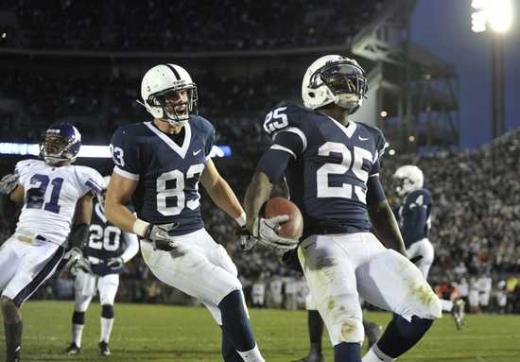
Forget the quarterback battle. (If Rob Bolden stays, he plays.)
At Penn State’s Blue-White Game on Saturday, all you really need to watch are the offensive line and the running backs.
Little else matters. Here are eight reasons why:
1. The Nittany Lions must replace three starting linemen – right guard Stefen Wisniewski, center Doug Klopacz and right tackle Lou Eliades.
The first two started every single game last season, while Eliades started the first four before getting injured. Of the other 35 starts, the trio of left tackle Quinn Barham (13), left guard Johnnie Troutman (11) and right tackle Chima Okoli (eight) grabbed the Lions’ share. That’s good.
But Troutman, who had a DUI in the offseason, has spent a bad amount of time in Joe Paterno’s doghouse (more room, I guess, still it’s been vacated by Brandon Ware). That’s bad.
Not good is that senior center Matt Stankiewitch missed the final seven games of the 2010 season with an illness. He’s started just twice, at guard, in 2009.
Also not good is that the right guard figures to be weak link. Sophomore John Urschel, a 4.0 student who earned high marks for playing 66 snaps against Indiana last year, has never started and is still green. And veteran DeOn’Tae Pannell is blue. He’s started nine games as a Nittany Lion, including the openers in 2009 and 2010. Both times, he failed to hold onto the starting job.
2. Joe’s worried. And I think he’s serious.
The line’s development, Paterno said on a Big Ten conference call this week, “is vital. We lost most of our entire offensive line. One of the projects we had this spring was getting the kids together who can play together and keep them healthy.
“Overall I think we’ve made some progress, but we still have a long way to go. We are not dominating much up front and we have troubles with some people that are stronger, maybe a little quicker. But technique-wise we are getting better.
“The camaraderie that you have to have on the offensive line and the pride you have that goes along with a good offensive line — we don’t have that yet. But we are working on it.”
3. This is yet another rebuilding project by offensive line Bill Kenney and Dick Anderson. Yet another.
“Dick and Bill are going to have to what they did last year,” Paterno said near the start of spring drills. “They took a bunch of kids that earlier in the year weren’t that good and at the end of the year they were a pretty good offensive line.”
Well, that’s debatable. (See No. 8.) And don’t forget that Penn State ranked ninth among 11 Big Ten teams in total offense in 2010.
And while we are at it, why is the Penn State offensive line a reconstruction job every season, anyway?
4. The tight end can be considered part of the offensive line.
And the tight end is in very shaky hands. Again.
Projected starter Andrew Szczerba never played a down in 2010, while his backup, Garry Gilliam, started three games then was felled by a torn ACL in his left knee. That left true freshman Kevin Haplea as the starting – and finishing – tight end. Brett Brackett kind of helped camouflage things, but he’s gone.
A year later, Gilliam is already out for 2011 with problems from a lingering infection. Szczerba, still plagued with a bad back, has not participated fully in spring practice. That leaves Haplea, occasional offensive lineman (and behemoth) Nate Cadogen and a couple of experiments at TE.
5. The health and experience of the running backs are questionable, to say the least.
Stephfon Green, now a senior, played 292 snaps last season, but he always seems plagued by injuries. Same goes for this spring. His spring uniform has included, at times, a red cross.
Green’s numbers are going down, not up. His carries have gone from 105 as a freshman to 71 to 48. That reflects a lack of confidence in, and/or by, him. His yards gained have gone from 578 to 319 to 188. And his per-carry average has gone from 5.5 yards to 4.5 to 3.8.
Funny, my IRA fell about the same amount during the same time.
Paterno’s stock in Brandon Beachum is up. He missed last season after knee surgery, but Beachum is a versatile player: he can catch, run, block and play special teams. He’s Joe’s kind of player. Mine too.
Full disclosure: When Beachum was considering Penn State, I had lunch with him and his family. I teach in Penn State’s College of Communications, and he was interested in that area of study.
He was a great kid that day, with caring (but didn’t seem like helicopter) parents. Well-spoken, polite, interesting and interested. Hard not to root for him.
Still, on the football field during live game action, he is mostly unproven.
As for sophomore Silas Redd. I know Penn State fans do not like to hear it, but he is mostly unproven too. They heard Evan Royster say that Redd could break all of his records. Maybe so. But he needs an offensive line to do it. And he needs to do better himself.
6. Everyone loves Silas, but on average, his numbers over the second half of the season don’t give me a rush.
Yes, his overall rushing average in 2010 was 5.7 yards, and he ran for 437 yards (explains, in part, Green’s diminished numbers). Misnomers, I say.
Over five of the final six games of last season, Redd’s rushing average was, well, average — 3.6 yards a game.
That number is based on throwing out Redd’s 11-for-131 yards performance against Northwestern, because — well, just about anyone can run against Northwestern. It’s an outlier.
Royster ran for 134 yards against the Wildcats that day, Green carried once for 21 yards and I think I saw Joe outrace NU coach Pat Fitzgerald to midfield after the game.
Northwestern aside, in the other five games, Redd averaged 4.0, 3.5, 5.5, 2.3 and 1.6 yards per game. That’s a whopping 133 yards on 37 carries.
Hardly the second coming of Blair Thomas. Or Tony Blair. Or even Danny Thomas.
“But,” you say. “That’s the offensive line, not him.”
My point, exactly.
7. The homestretch of Penn State’s 2011 regular season could be brutal.
Penn State’s final 15 days of the regular season are Nebraska at home Nov. 12, at Ohio State Nov. 19 and at Wisconsin Nov. 26. Yikes…the Three Horsemen of the Apocalypse. Legends and Leaders all.
Very quickly, they could turn a 7-2 record into a 7-5. Or a 6-3 into a 6-6.
Arguably, it is the toughest three-game regular season finishing stretch of the Paterno era. Only six times since 1966 have the Nittany Lions faced two ranked teams in their final three games –1981, 1982, 1995, 1996, 1999 and 2010.
The toughest final three was the province of the 1981 squad, which finished by losing to No. 6 Alabama (31-24) and beating unranked Notre Dame (24-21) before waging a huge comeback to win 48-14 at No. 1 Pittsburgh.
It’s not hard to see the Huskers, MakeaBuckeyes and Wisconrunup-the-score all being ranked when they play Penn State.
8. The running game will make or break Penn State in those final three games.
It will be Big Ten weather in the Rust Belt in November — cold, snow, wind, Joe’s parka. Spread offenses huddle for warmth. Passing attacks are passé. Three yards and a cloud of visible breath.
Teams that are physical along the line and dominate the ground game will prevail. And that is where, recently, we have seen Penn State fail.
Even with Royster, the all-time leading rusher, and Wisniewski, an All-American, Penn State simply could not run the ball in November and in the postseason the past three years.
Over its last 13 games of the past three seasons – four in 2010, four in 2009 and five in 2008 – Penn State has had only one rusher run for more than 100 yards. One. That was Evan Almighty, with 114 yards against Michigan State. Even that was odd, since the Spartans’ defense crowds the line, taking away the run and almost daring the opposition to pass.
Other than that, the Lions’ rushing game numbers for the second half of the season looked like Tom Corbett got ahold of them.
Over those 13 games, Penn State was 7-6, with losses to such quality opponents as Ohio State (twice), Florida, Michigan State, Southern Cal and Iowa. The wins came against Indiana (thrice), Ohio State, LSU and Michigan State (twice).
Through 1998, Joe won November and December regular season games at a .789 clip (91-23-2). Since the oh-for-three collapse of 1999, Penn State has been 23-17 in regular season games in November and December. Those 17 losses equal the TOTAL number of losses by the Nittany Lions in all the November-Decembers of the 1960s, 1970s and 1980s. That’s 24 years vs. 13 years.
WEATHERING THE STORM?
I’m no Lee Corso, but when the temperatures fall, Penn State’s running backs and offensive line are probably going to be more important than its quarterback(s).
So, listen to all the hype about Paul Jones (no way is he starting in September), Matt McGloin (he starts if Bolden leaves) and Bolden (Joe desperately hopes he starts). But remember this:
It’s only a spring scrimmage in Beaver Stadium on Saturday.
But when November comes, it is the hopes of a Nittany Lion running game that will spring eternal.
Related coverage
More Columns
View all Columns
Column: The Penn State Men’s Basketball Paradox
Penn State has always been and likely will always be a sports school, first and foremost. With 85 team national championships, 335 conference championships (regular season plus tournament), a historic […]
The Following Column Was Written by Russell Frank… Honest
During a strategy session about our fall classes – yes, the 2026-27 academic year is nearly upon us – one of my colleagues confessed to using AI to generate the […]

Hook: Reflections on an Intriguing and Expensive World Cup
According to media reports, the FIFA World Cup final is the most-watched sporting event in the world, and although as I write this the viewership numbers have not been released […]


